
For golf simulator dealers and commercial installers, the projection impact screen is the most critical consumable and operational component in any simulator enclosure. One needs rolls for local cutting and sewing; the other needs finished panels with dimensions and attachment details agreed before delivery.
Both decisions start with the project. What will the screen do? Which materials should be sampled? Who will turn the fabric into an installed screen?
This guide takes the next step: comparing golf simulator screen fabric options, choosing a supply format, and preparing a bulk inquiry. ImpactScreenGolf supplies both fabric rolls and custom-finished screens for project buyers.
(Our retractable golf simulator systems sourcing guide covers the wider system decision. )
1. Define the Project Before Choosing a Fabric
Start with a short project brief that your purchasing, fabrication, and installation teams can all use. Include:
- The application: residential installations, coaching studios, commercial bays, or a dealer product range.
- Expected use: occasional practice, regular lessons, or extended daily operation.
- The screen dimensions, projection area, and room lighting conditions.
- The installation: fixed frame, replacement panel, or retractable system.
- Any specified fire-retardant requirements and supporting documentation needed.
- The quantity, delivery destination, and intended installation schedule.
(For a retractable project, include the roller and attachment details in the brief. Confirm the proposed material and finished construction with the system supplier before ordering. Suitability for a fixed frame does not establish compatibility with a particular roller assembly.)
2. Compare the Main Screen Fabric Options
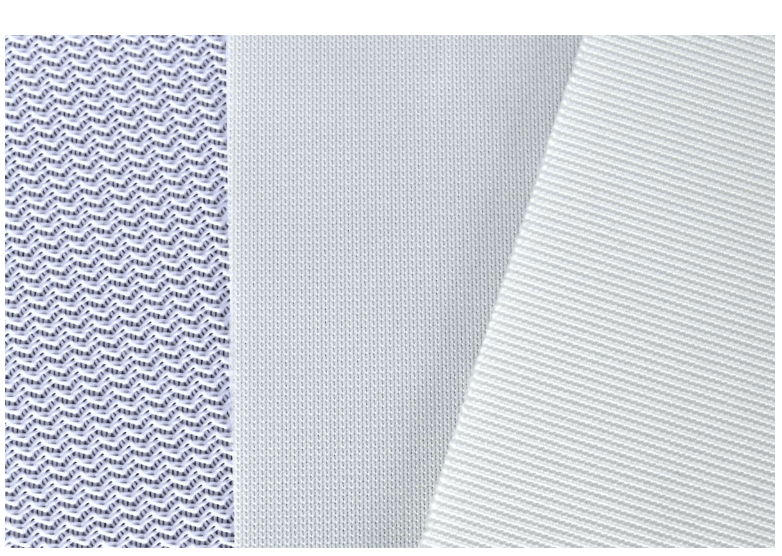
The golf simulator screen fabric range includes single-layer white materials, a white triple-layer option, white and grey fire-retardant options, and black backing fabrics.
| Fabric option | Listed specification | Reason to include it in your shortlist |
|---|---|---|
| Single-layer white fabric, 275 or 360 GSM | White, 100% polyester, two single-layer weight options | • Crisp 4K opticals • Lightweight profile • Requires back-pad |
| Single-layer white fabric, 410 GSM | White, 100% polyester, single-layer construction | Cost-effective materials for entry-level and mid-range simulator projects |
| White triple-layer fabric, 480 GSM | Three-layer spacer mesh; approximately 3.36 mm thick | • Air-cushion core • High impact dampening • Ultra-low noise |
| White fire-retardant fabric, 530 GSM | Three-layer spacer mesh; approximately 3.4 mm thick | Projects requiring a white screen and review of fire-retardant specifications |
| Grey fire-retardant fabric, 475 GSM | Grey projection surface; approximately 3.1 mm thick | Comparing a grey surface in the intended lighting environment while addressing fire-retardant requirements |
Single-Layer or Triple-Layer?
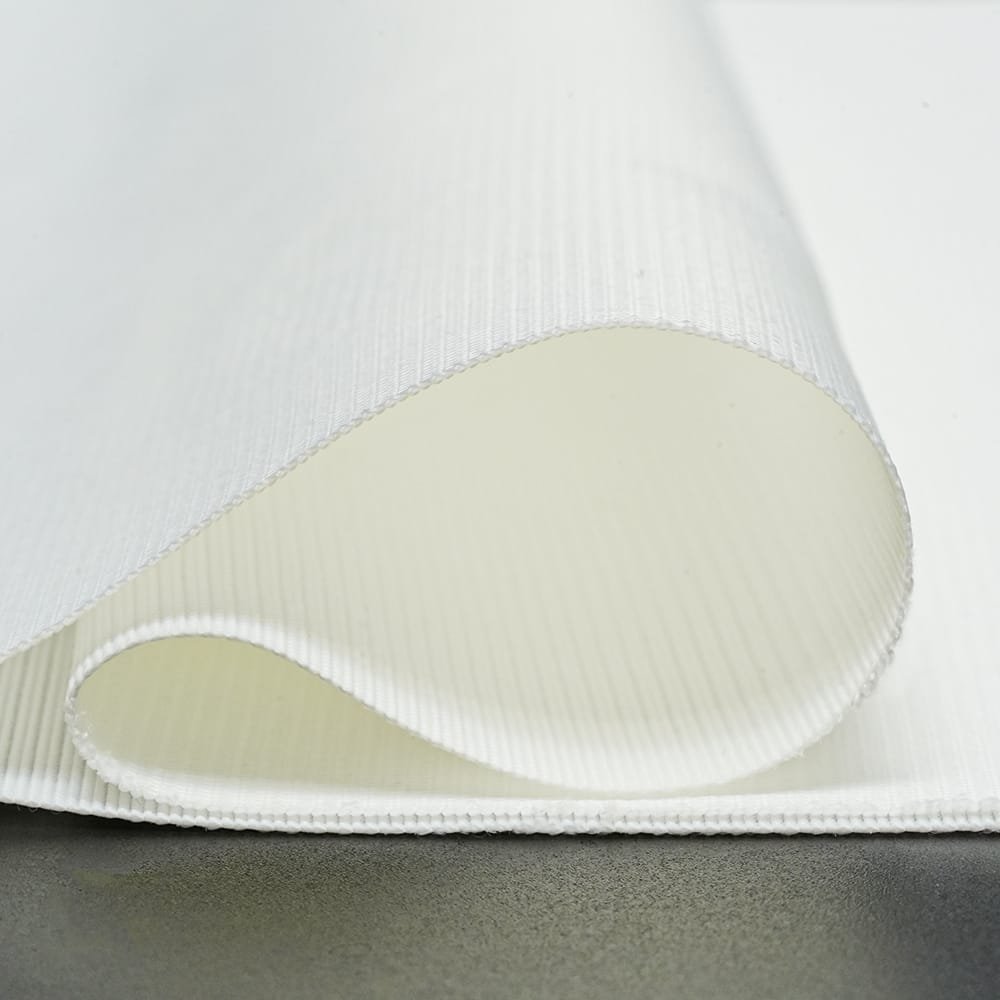

Single-Layer Heavy-Duty Polyester
Structure: A dense, flat-woven or tightly knit high-tenacity polyester surface.
Optical Quality: Exceptionally sharp image clarity. Because there is no internal cushion layer, pixel geometry remains crisp, making it ideal for high-resolution 4K laser projectors.
Acoustics & Bounce-Back: Produces a louder “crack” or snap on ball impact. Requires careful perimeter tension management and an independent rear acoustic backing to prevent aggressive bounce-back.
Best Suited For: Budget-conscious builds, installations where projector sharpness is prioritized, or retrofit bays with existing heavy-duty netting/cushioning behind the screen.
3-Layer Spacer Fabric (Sandwich Mesh)
Structure: Two exterior fabric faces connected by an internal matrix of micro-monofilament yarn. This creates an integrated, shock-absorbing “air cushion” layer.
Optical Quality: Smooth, tight-knit strike face designed for HD/4K projection with minimal grain.
Acoustics & Bounce-Back: The internal filament layer collapses momentarily on ball strike, dissipating kinetic energy laterally. This cuts impact noise to a muffled “thud” and drops the ball safely within 1–3 feet of the screen.
Best Suited For: High-end residential builds, commercial venues with noise restrictions, and any bay where customer safety and quiet operation are paramount.
White or Grey?


| Comparison | White Screen Surface | High-Contrast Grey Surface |
|---|---|---|
| Colour Reproduction | Excellent colour vibrancy and accurate colour temperature. | Deepened black levels, reduced wash-out. |
| Ambient Light Tolerance | Low to moderate; performs best under controlled lighting. | High; performs particularly well in open spaces with supplementary lighting. |
| Projector Requirements | Standard commercial lumens. | Higher lumen output recommended. |
| Recommended Applications | Dedicated simulator rooms and residential studios. | Sports bars, training academies, and multipurpose recreation rooms. |
When Fire Retardancy Is Necessary
Shortlist the white 530 GSM or grey 475 GSM fire-retardant option when the project specifies that requirement. (For more on preparing a commercial project brief, see our commercial golf impact screen selection guide.)
Need help narrowing the options? Send your project brief and ask about suitable fabric samples.
3. Include Backing and Enclosure Fabric in the Material Schedule
Once the main screen is shortlisted, list the rear, side, and top panels separately. Our black backing and enclosure fabric has two listed options:
- 250 GSM, approximately 2 mm: positioned for rear blackout backing and light-duty side panels.
- 480 GSM, approximately 3 mm: positioned for rear backing, side panels, and ceiling protection applications.
Our black backing and baffles guide discusses their roles in more detail. For a quotation, identify each panel’s location, size, quantity, and required finish.
4. Choose Fabric Rolls or Custom-Finished Screens
MESHGOLF supports both supply routes. The right choice depends on where cutting and finishing will happen and how your team wants to organise the project.
| Supply format | A practical fit when… | Details to agree before ordering |
|---|---|---|
| Fabric rolls | Your business cuts and sews locally, works with a fabrication partner, or needs material for several screen sizes | Material reference, usable width, roll length, quantity, tolerances, roll identification, and packaging |
| Custom-finished screens | Your team wants panels made to an agreed drawing for installation or replacement work | Finished dimensions, projection area, edge construction, attachment positions, tolerances, quantity, and panel identification |
Buying Rolls for Local Fabrication


Fabric Model / Architecture: (e.g., Heavy-duty single-layer woven vs. 3-layer spacer mesh; white vs. grey).
Usable Width: Confirm the usable width (excluding selvedge edges). Common widths for in-stock fabrics are 3.2 m. (Customization available).
Roll Length & Minimums: Standard rolls typically range from 25 m to 50 m per roll.
Core and Packaging Specs: Ensure rolls are wound on rigid heavy-gauge cardboard cores with moisture-barrier outer wraps to prevent transit flattening or creasing.
Include your own cutting, sewing, inspection, and material waste in the comparison. Roll supply allows you to organise local fabrication; the value of that flexibility depends on your equipment, labour, and order mix.
Buying Finished Screens for Installation


Finished Outer Dimensions (Width × Height): Define whether your dimensions represent edge-to-edge fabric size or grommet-center to grommet-center.
Perimeter Reinforcement (Webbing): Heavy-duty ballistic seatbelt webbing sewn with multi-row commercial stabilized thread to distribute tension across the perimeter.
Attachment Hardware & Spacing:
Grommets: Inner diameter, material, and center-to-center spacing.
Hook-and-Loop (Velcro): Industrial loop/hook strips sewn to perimeter edges for tool-free, baffle-integrated attachment.
Pole / Pipe Sleeves: Top or bottom pipe pockets for weighted bottom rods or ceiling-mounted roller attachments.
Bay Labeling / Custom Tagging: If ordering multiple bays of varying dimensions, request individual bay tags on each package to prevent installation mix-ups on site.
Can One Project Use Both Formats?
Yes. You can request a quotation for finished main screens alongside rolls for locally fabricated backing. List each item separately so material quantities, processing requirements, and delivery arrangements remain clear.
5. Request Samples, Roll Pricing, or a Custom Screen Quote
Whether you fabricate locally or install finished panels, selecting the right partner and delivery format ensures predictable installations and minimal callbacks.
Send the information you have:
| Inquiry item | What to include |
|---|---|
| Business and application | Dealer, installer, integrator, or brand; intended project type |
| Supply format | Fabric rolls, custom-finished screens, or both |
| Material | Preferred product reference, or the options you want to compare |
| Dimensions and quantity | Required width and length for rolls; panel dimensions and quantities for finished screens |
| Installation details | Fixed or retractable system, frame information, and attachment requirements |
| Project requirements | Projection environment, expected use, and any specified fire-retardant documentation |
| Delivery | Destination country or region and target schedule |
If you have not selected a fabric, send your project brief first. We can discuss a sample shortlist and the information needed for a quotation.
Frequently Asked Questions
Can I buy fabric rolls and finished screens from the same supplier?
Yes. MESHGOLF supplies both formats. Specify the material and quantity for each part of the inquiry, along with any cutting or finishing required.
How do I choose between 275, 360, and 410 GSM single-layer fabrics?
Use the weights to identify the materials you want to compare, then evaluate samples against your project requirements. Weight alone does not establish which option offers the best projection, impact response, or service life for your installation.
Can black enclosure fabric replace the main impact screen?
The black range is intended for backing and enclosure applications. Select a dedicated white or grey impact screen fabric for the main hitting and front projection surface.
Can these materials be used in a retractable screen system?
Confirm compatibility for the specific material, finished panel, roller, and attachment method. Include system details in the inquiry so that suitability can be reviewed before an order is placed.
What are the minimum order quantity and lead time?
Request these with your quotation. The material, supply format, quantity, finishing requirements, and current production schedule need to be established before order-specific terms can be confirmed.
